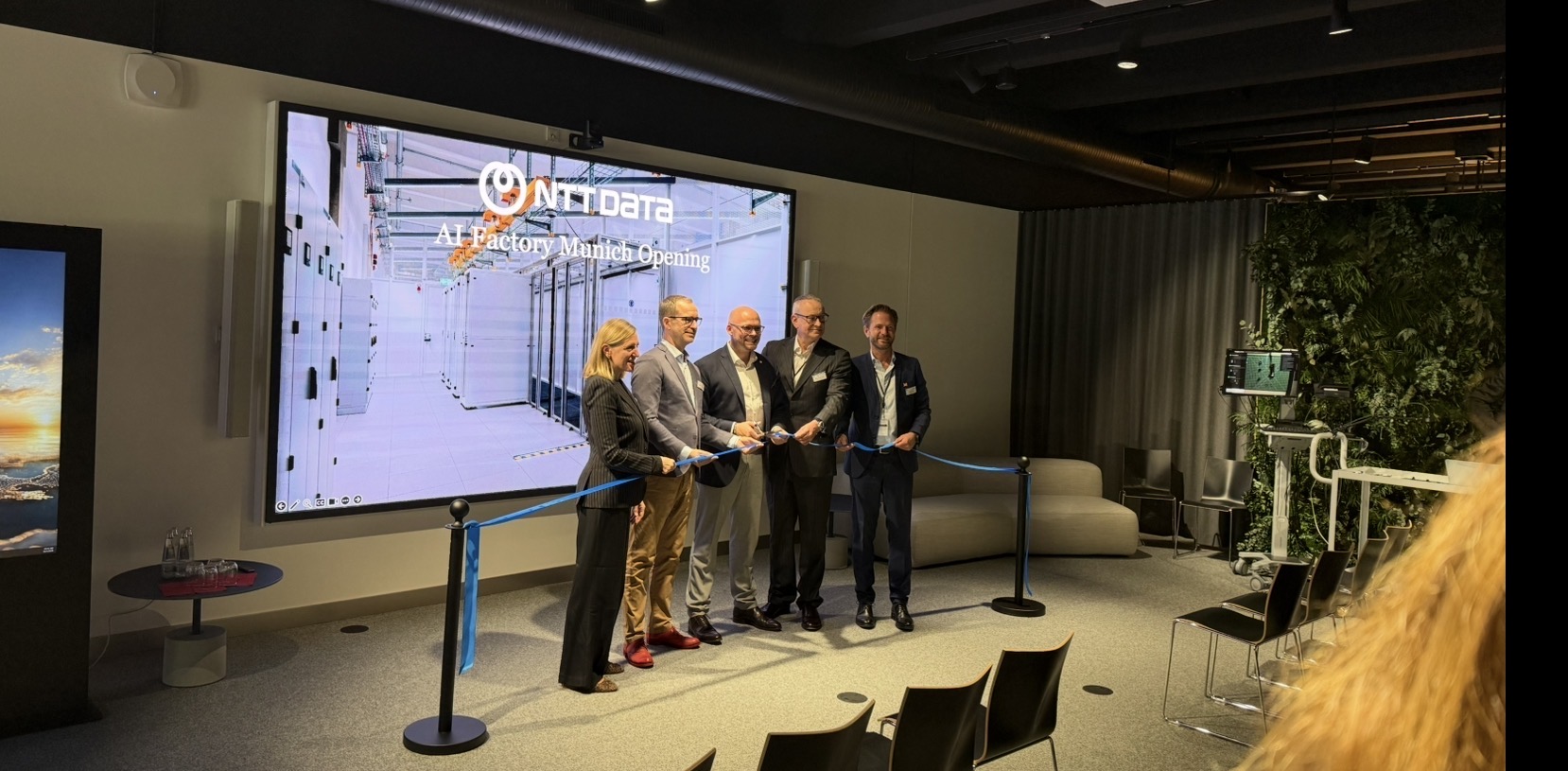
Anne-Sophie Lotgering, Europe CEO of NTT Data, on why AI in production will create new business models and revenue, not just savings. Interview from Munich.
The interview with Anne-Sophie Lotgering, Europe CEO of NTT Data, seemed to be over. We had spent a quarter of an hour on sovereignty and productivity in a small meeting room at NTT Data’s Munich 2 data centre on the edge of the Bavarian capital; there was time left for one question that wasn’t on my list. It is a subject close to my heart, one that had struck me in the words of the Nobel laureate Philippe Aghion, and perhaps the most obvious question of all: “Many companies are adopting artificial intelligence to save money: why do so few use it to reinvent their business?”
Anne-Sophie Lotgering, answered (you can read her reply further down), made to leave, then turned back: “I’m really glad you asked me the question about revenue generation, because I think it absolutely is the key.” In a sense the whole interview is already there: a genuine conviction that AI is far more than a tool for optimising, streamlining or, in a word, saving money.
Anne-Sophie Lotgering has led NTT Data in Europe since 1 September 2025, having previously run Proximus NXT IT and held senior roles at Orange and Microsoft (the appointment announcement). On 7 October she was in Munich to open the group’s Enterprise AI Factory, a production environment built with Dell Technologies, Red Hat, Mistral AI and NVIDIA on the Unterschleißheim campus, where companies can test their AI use cases before taking them to scale. Digitalic met her on the sidelines of the launch. This conversation starts where it ended.
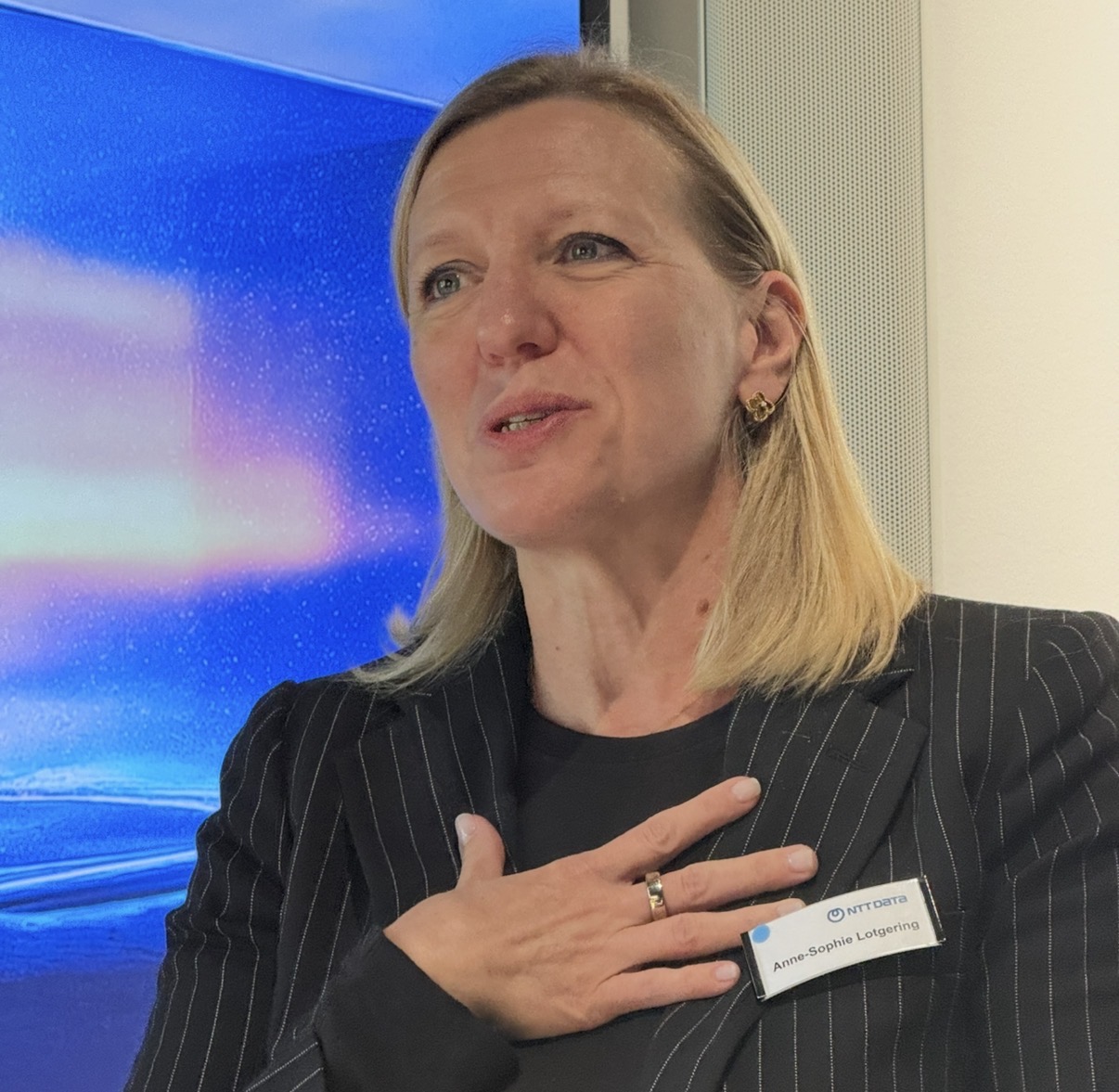
Anne-Sophie Lotgering, CEO NTT Data Europe
Indice dei contenuti
Revenue above the line
Lotgering’s answer to the question of why so few companies use AI to reinvent their business begins with the way companies talk about AI to the markets: “A lot of companies communicate to markets today about what they’re going to be doing in terms of efficiency gains, and they don’t yet communicate how moving to production will enable them to actually capture additional revenue. That’s because of where we are in the evolution of AI adoption today.”
Where we are, as she reads it, is a phase of transition; the forecast she draws from it is straightforward: “I am absolutely convinced that as clients go from pilot to production, it will create new business models, it will create new intimacy with clients, it will create a different way for them to reimagine the business that they have today. You will see a lot more communication around the revenue impact, so I would say the above-the-line impact, than what we see today. I’m convinced of it, and this is why helping our clients do just that, understanding how we move use cases from pilot to production, is so important. It’s one of the reasons why we’ve created this factory here in Munich.”
“Above the line” is the language of the accounts: revenue sits at the top, costs below. Until now AI has made its way into analyst presentations almost always from the bottom, as a saving; Lotgering is betting that over the coming quarters it will climb to the top of the income statement. It should be said that this is also the commercial bet of a company that sells services to take AI into production, so it is best read as the forecast of an interested party rather than as a finding.
To explain how spending is split today, she recounted a conversation with a client: “He said: ‘I have three types of AI projects in my company. I have AI for everyone, which is how to democratise AI and use licences for better efficiency. Then I have AI for business process optimisation, which is also efficiency-led but can yield additional revenue. And then I have this pot of AI for transformation.’ Which is exactly what we’re talking about: reimagining completely how you run your business and how you can create additional outcomes through that, which is growth. At the end of the day, I believe that AI can actually enable growth.”
In corporate parlance a “pot” is a budget allocation. Her client, then, has three separate lines of spending, and the real question for any CIO or CFO is how much the third weighs against the first two.
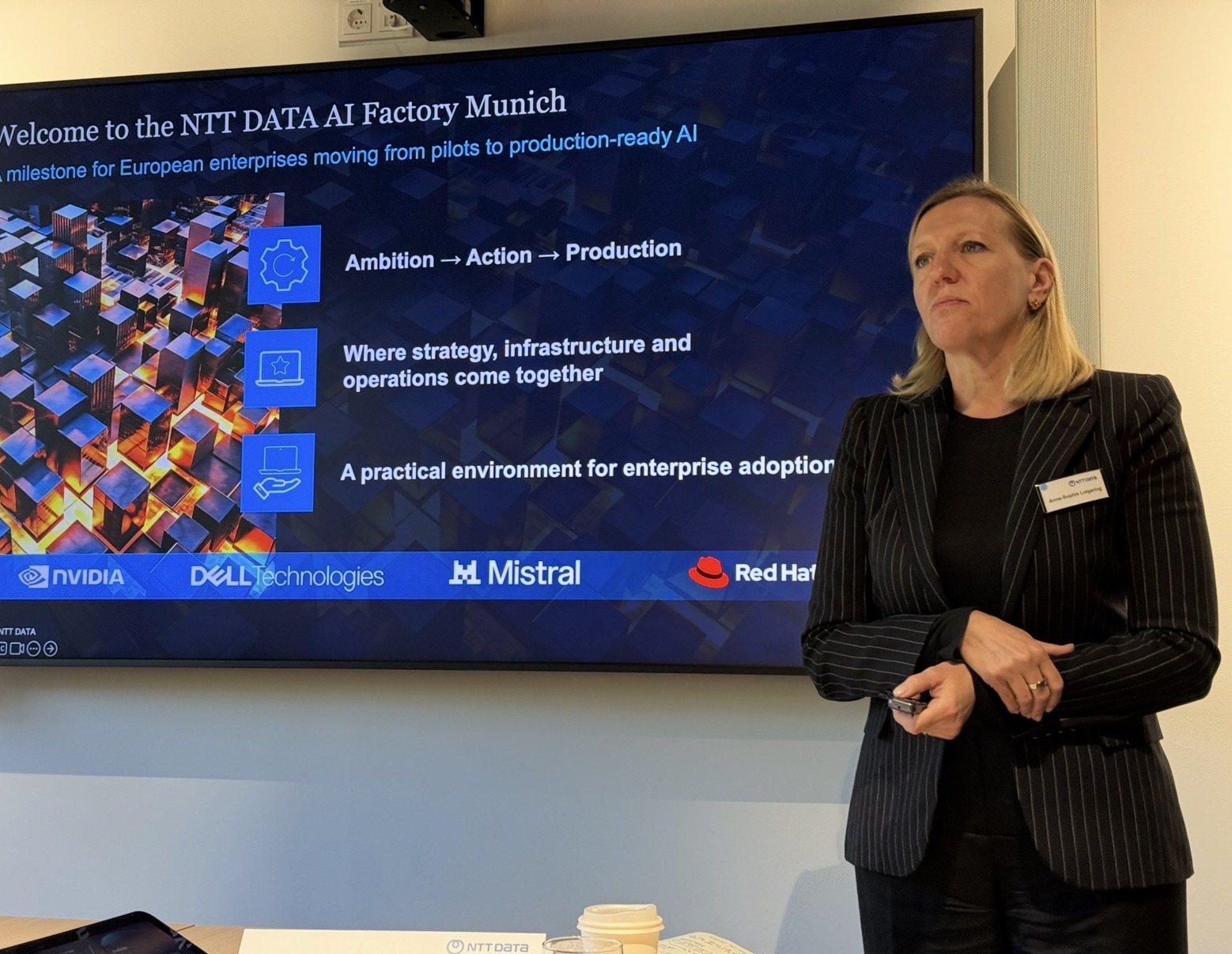
Anne-Sophie Lotgering
Aghion’s fist
The idea behind that final question was not entirely my own, as I admitted to her. It comes from Philippe Aghion, winner of the 2025 Nobel Prize in Economics, whom I had watched bang his fist on the table at the Brussels Economic Forum in May to argue that Europe needs more creativity, not merely more efficiency. Aghion had shown how much of the research behind high-tech innovation originates in Europe while the products are launched in San Francisco or Shenzhen, and had argued that AI will destroy jobs but create many more (the full article, in Italian); his voice, recorded in Brussels, features in the DigitMondo episode dedicated to Aghion.
Lotgering picked up the thread and carried it on to more delicate ground, that of work: “I think it will also dispel some of the fear that we have today around AI and what it means for the labour market, because it will create a completely different outcome.”
The link deserves a line of explanation. AI presented purely as a cost-cutting tool wears, in the eyes of the workforce, the face of an auditor hunting for waste to eliminate, and waste often turns out to mean people. AI presented as a tool for recombining ideas and producing things that did not exist before is more powerful, and easier to accept.
Where Anne-Sophie Lotgering draws the line on sovereignty
The interview had started somewhere else entirely, with a question about the word that ran through the whole morning in Munich. NTT Data presents the AI Factory as sovereign infrastructure, yet among its most important partners are the American hyperscalers: when do you need purely European infrastructure, and when is the sovereign offering of the big US players enough?
Lotgering first widened the frame: “We have strategic relationships with the hyperscalers such as Microsoft, AWS and Google, but of course we also have strategic partnerships with OpenAI and others. What is most important for us is to be able to advise our clients on the best technology for what they want to do with AI; and this is why, by the way, we’ve created the AI Factory. We’re able to test models in a real, live environment which is production-grade, and coming out of that testing we’re able to provide them with what we call a reference architecture: a document where we say which type of technology you should be using to run which workload, and at what return on investment.”
She then set out the range of options: “Depending on the workload, it could be running on a hyperscaler public cloud, on a hyperscaler sovereign cloud, on a hyperscaler disconnected offer, or on a pure sovereign stack. As an IT services provider we are, of course, agnostic in terms of technology: we want to make sure that we provide the best reference architecture for the workload our clients want to move from pilot into production.”
The criteria for choosing between those four tiers will be familiar to any compliance officer: “We look at what the client is using today, at how critical the different workloads are, and then at compliance, regulation, jurisprudence and the use they want to make of them. If working on the public cloud is in line with what the client wants, it could be AWS, it could be Microsoft, it could be any hyperscaler; if not, we can advise on the sovereign offers of those same hyperscalers, just as we can propose a fully private and sovereign infrastructure if that is what the client wants. So it’s really about understanding the client’s legacy, what type of pilot they want to move into production, and what that means for the technology stack they should be using.”
Her answer turns sovereignty from a choice of sides into a sliding scale, to be decided project by project. The line is drawn by the criticality of the data and the rules that apply to it rather than by the supplier’s flag, starting with the AI Act, whose penalty regime took effect on 2 August 2026. It is a pragmatic position, and the most consistent one for an integrator that works with all the leading technologies.
At Digitalic we have written about how digital sovereignty has become a matter of infrastructure and operational continuity before it is a political one, and about how NTT Data’s Global AI Report 2026 names data sovereignty as the top governance concern for 59.4 per cent of the companies most advanced in AI. At the Brussels Economic Forum the most radical position came from Frank Karlitschek, founder of Nextcloud, in the DigitMondo episode on digital sovereignty: Europe has the companies and the skills; what it lacks is the courage to buy from them.
Where productivity goes
The second question was about her own house. AI promises productivity gains above all in IT services, which is to say in NTT Data’s own line of business: does that extra margin end up in lower prices for clients, in research and development, or in the company’s margins?
Lotgering began with a premise few executives say out loud: “We’re human beings, so it’s very difficult to measure the productivity of a human being. You don’t see an efficiency-per-human-being line in your profit and loss statement.”
She went on to describe the group’s strategy: “We have a three-pronged strategy around AI. We want to make sure that our offers and solutions are AI-enabled. We want to make sure as well that we use AI within our own business processes, so we’re our own client zero: we do that, for example, in our technology solutions business, with our level one, level two and level three engineers, where we look at how we can use agentic AI to make the process a lot quicker and be a lot more efficient for our clients. The third pillar is about how we advise our clients to enable their AI journey.”
Internally, NTT Data has concentrated agentic AI on two areas: finance, and everything to do with marketing. The most concrete detail of the interview came here: “Today, in our operations, we have an agentified workforce: agents working side by side with humans.”
On the precise question of where the freed-up margin goes, Lotgering did not offer a breakdown. She turned instead to the method she recommends to clients: “It’s not about creating a hundred thousand projects and then trying to measure the efficiency out of that. It’s about looking at what impacts the P&L most, in terms of processes. For insurance, it could be claims and underwriting; for banking, loans, payments, know your customer; for manufacturing, supply chain, everything linked to product management. Then we look at those end-to-end processes and we say: choose one or choose two, but really decide, because those will have the biggest impact on your P&L.”
Licences and proofs of concept
For clients looking to take AI into production, Lotgering’s measure of success is a single one: the impact on the P&L. To explain it she retraced the past two years with a picture anyone who has rolled out licences across a company will recognise: “Companies started by doing lots of proofs of concept. They provided Copilot licences to employees, who started using them, and it created productivity. But where does that productivity gain go? Does it go into doing other tasks?”
The way out she proposes brings both halves of the accounts together: “In order to see an impact on their P&L, they should be looking at one or two end-to-end processes across their company that they can reimagine through agentic AI. That will have a real impact on their revenue, because they know their clients better and they’re able to fulfil demand more quickly, and it has an impact on the bottom part of their P&L, because they’ve enabled themselves to be more efficient and to save money. That’s what companies are looking at today when they move to production: how quickly can I see the impact.”
The end-to-end process formula is nothing new in consulting; what is new is the open acknowledgement that the era of widespread licences produced a real gain that is hard to pin down, scattered across a thousand small savings of time that never show up in the accounts.
Anne-Sophie Lotgering on both sides of the table
Lotgering also sits on the boards of companies that buy AI, so she sees the technology from both sides. We asked her what changes between those whose job is to spread it and those who have to use it: “If you’re advising your clients on how they should use artificial intelligence, your first responsibility is to be able to apply it to yourselves, whether within your own processes or by making sure that the experts you put in front of clients are always technology-savvy and future-ready, and understand how the technologies are evolving and where the market trends are. So for me the biggest difference is that we have a responsibility towards our clients: to anticipate, and to adopt AI ourselves in such a way that we’re then able to advise our clients based on our own experience too.”
Seen this way, the client-zero formula becomes a condition of credibility: a consultant who asks clients to reimagine their processes has to be able to show its own, finance and marketing included.
The next chapter
Read in full, the interview follows a consistent path. Lotgering describes AI adoption as a journey in stages: first widespread licences, then end-to-end processes, finally the transformation of the business. NTT Data applies the same path to itself, starting from its role as client zero, with finance and marketing functions in which agents and people work side by side; a way of approaching clients with first-hand experience before any commercial proposal.
Her thesis has the merit of being testable: market presentations over the coming quarters will show how quickly AI rises above the line, from costs avoided to new business. Lotgering said more than once that she is convinced of it, and the AI Factory in Munich is how NTT Data has chosen to support that shift. The question Aghion put in Brussels, how to turn European research and efficiency into growth, finds one of its possible answers here; the next ones will probably come from the clients who walk out of that room with a project ready for production.